The core theme of Ignite 2025 is that organizations are now positioned to become what Microsoft calls “Frontier Firms,” hybrid workplaces where human judgment and AI agents work side by side to get real work done.
Rather than treating AI as an occasional helper (a chat window or an autopilot), Microsoft is reimagining AI as a first-class citizen in workflows, agents that can act autonomously or semi-autonomously, with governance, security, and integration across the cloud, data, apps, and devices.
Across announcements, three major themes stood out:
- Agentification, more AI agents embedded in everyday tools, not just standalone chatbots.
- Governance & Security for AI agents, enterprises get control, visibility, and compliance over agents.
- Deep integration of AI throughout cloud (Azure), productivity apps (Microsoft 365), and platforms (Windows/Windows 365).
What’s new in Microsoft Office 365 & Copilot
Microsoft introduced Agent 365 to help organizations securely deploy and govern AI agents across Microsoft 365. Copilot also gained new Agent Modes for Word, Excel, and PowerPoint, enabling users to generate documents, analyses, and presentations through interactive, context-aware AI workflows.
Microsoft Agent 365
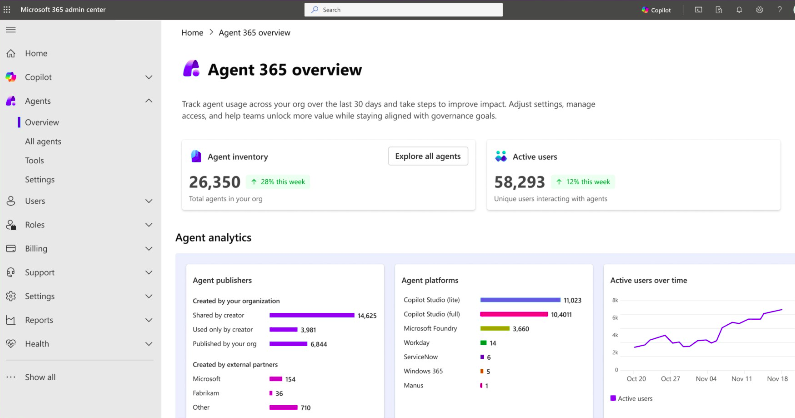
- Agent 365 is now available in the Microsoft 365 admin center (via the Frontier early-access program) to help organizations deploy, monitor, govern, and secure AI agents at scale.
- It provides a registry of all agents (including “shadow agents”), along with agent IDs, access control, real-time monitoring of agent behavior, lineage (which agent touches which data), interoperability with apps, and security via integrations with Microsoft Defender, Microsoft Entra, and Microsoft Purview.
- This lets enterprises manage not only human users, but digital workers (agents) with the same level of governance, reducing risk while embracing AI-based workflows.
Copilot gets “Agent Mode” across Office apps
- The acclaimed Microsoft 365 Copilot now supports specialized agents for Word, Excel, and PowerPoint, through which users can generate documents, spreadsheets, and presentations, not by opening each app and customizing manually, but by prompting via Copilot Chat. These agents then ask follow-up questions to tailor the output in terms of formatting, layout, content, and style.
- Agent Mode in Word is now generally available; Excel Agent Mode lets users choose reasoning models (e.g., from Anthropic or OpenAI); and PowerPoint Agent Mode is in the Frontier preview program.
- Work IQ Integration: Work IQ merges data from your documents, emails, meetings, and chats (i.e., your “work graph”), your working patterns/preferences, and context to let Copilot anticipate needs and deliver more contextual, relevant assistance.
Copilot is getting more innovative, more integrated, and enterprise-ready
- Copilot’s ambitions go beyond “assist me” with agents, it becomes a productivity engine embedded in core Office workflows.
- For enterprises, the combination of Agent 365 + security & governance tools means deploying AI agents at “human-agent workforce” scale, with traceability, audit logs, and compliance controls.
What’s new in Azure, Cloud, and Infrastructure
- The cloud side is getting significant AI-first upgrades, with Azure offering new “intelligent cloud” capabilities designed to unify data, apps, infrastructure, and AI at scale.
- According to the Azure blog from Ignite 2025, Microsoft is enabling companies to adopt an “AI-first” strategy, giving them a platform ready for building, deploying, and managing agentic workloads and AI-infused apps.
- As part of this, there are new AI infrastructure innovations and support for agent-based scenarios, including integration with Azure services for deployment and scaling of these agents.
- For companies building AI apps/products, this means Azure is not just storing or computing; it’s becoming a full-fledged agent-ready AI backend across data, computer, security, and deployment.
New AI-driven, real-world agents
One of the most significant UX-shifting announcements: AI agents doing real business tasks. For example:
- A new Sales Development Agent, currently in Frontier preview, is intended to help sales teams automatically research leads, qualify them, and even follow up (outside business hours), helping scale revenue operations. This agent is built with the same security/governance framework as Agent 365.
- Agents embedded in communication channels: Agents inside Microsoft Teams channels can now integrate with third-party apps (e.g., task trackers, issue management tools like Jira, project-management apps, and more) using the emerging protocol Model Context Protocol (MCP). For instance, you could ask an agent to surface project blockers in Jira and automatically schedule a meeting. This is now in preview.
- The point: AI agents are no longer isolated to a single app/chat system. They can be part of workflows, systems, and third-party apps. That’s a significant shift.
Governance, Compliance & Security for an AI-Driven Enterprise
With increasing power comes increasing risk, misuse of data, privacy & compliance issues, rogue agents, data leaks, etc. At Ignite 2025, Microsoft addressed this head-on:
- Through Agent 365, enterprises get complete visibility: a registry of all agents, including unauthorized “shadow agents.”
- Access control and conditional access policies: agents can be limited to only the resources they need, reducing the risk of overprivileged agents.
- Real-time monitoring and logging of agent behavior: administrators can track which agent accesses what data, when, and how, enabling auditability and compliance.
- Integration with security & compliance tools (Defender, Entra, Purview), meaning agents are covered by the same enterprise-grade security posture as human users.
This pushes back firmly against a common criticism of AI adoption: “How do we trust, govern, and control these systems?” Microsoft’s answer is to treat agents like first-class entities, with identity, policies, monitoring, and governance.
What does this mean for companies, developers & everyday users
If you are in IT leadership, cloud architecture, enterprise management, or even small businesses, here’s how these announcements could impact you:
- For enterprises: It’s now feasible to deploy and manage AI agents at a scale securely. That means automating repetitive tasks, scaling sales outreach, automating reports, presentations, and document creation, and integrating AI into workflows, without throwing away your existing infrastructure or compromising compliance.
- For knowledge workers: Tools like Word, Excel, and PowerPoint are evolving, with less manual layout, formatting, and research; more natural-language prompts that generate finished or near-finished output. This could dramatically boost productivity.
- For developers & architects: Azure becomes more attractive as a full-stack AI backend. If you’re building AI apps, you can combine data, computer, agent orchestration, security, and deployment from a single ecosystem.
- For organizations concerned with governance: Agent 365 + security stack offers a path to adopt AI without exposing sensitive data unthinkingly, because you have visibility, controls, and audit capabilities.
Summing up
Microsoft Ignite 2025 isn’t just another update-laden conference. It’s a signal: the AI-agent era is here. By building a comprehensive stack, from cloud + infrastructure to productivity apps, agent management, security, and real-world agents, Microsoft is committing to a future where human-AI collaboration is central to business operations.
For organizations willing to embrace this, the potential upside is huge: automation at scale, more intelligent workflows, less friction, and new levels of productivity. For users, the “computer + assistant” model shifts to “human + agent coworker.”